The NFB is committed to respecting your privacy

We use cookies to ensure that our site works efficiently, as well as for advertising purposes.

If you do not wish to have your information used in this way, you can modify your browser settings before continuing your visit.

Learn more
Skip to content Accessibility

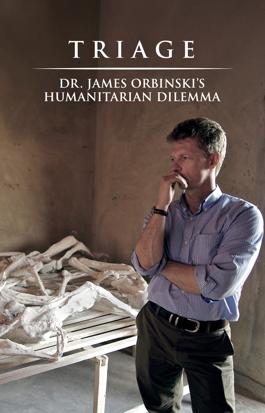
Triage: Dr. James Orbinski's Humanitarian Dilemma

In this vérité feature documentary, we travel with Dr. James Orbinski from Toronto where he is a father, doctor and teacher, back to Africa where he spent years as a field doctor, as he embarks on writing a personal and controversial book about his humanitarian experiences. Dr. Orbinski accepted the 1999 Nobel Peace Prize on behalf of Médecins Sans Frontières (MSF) as their President, and was a field doctor during the Somali famine and the Rwandan genocide, among other catastrophes. In this film, and through his personal perspective, we look at the act of triage. Racing against time with limited …

Your rental expires on
None
You've already purchased this film.
Download it from My purchases.

Details

In this vérité feature documentary, we travel with Dr. James Orbinski from Toronto where he is a father, doctor and teacher, back to Africa where he spent years as a field doctor, as he embarks on writing a personal and controversial book about his humanitarian experiences. Dr. Orbinski accepted the 1999 Nobel Peace Prize on behalf of Médecins Sans Frontières (MSF) as their President, and was a field doctor during the Somali famine and the Rwandan genocide, among other catastrophes. In this film, and through his personal perspective, we look at the act of triage. Racing against time with limited resources, relief workers make split-second decisions: who gets treatment; who gets food; who lives; who dies. By the creative team behind the award-winning documentary Shake Hands with the Devil: The Journey of Roméo Dallaire.

 This work deals with mature subject matter. Viewer discretion is advised.
  • director
    Patrick Reed
  • producer
    Peter Raymont
    Silva Basmajian
  • editor
    Michèle Hozer
  • photography
    John Westheuser
  • sound recording
    Ao Loo
  • executive producer
    Silva Basmajian
  • music
    Mark Korven
  • production supervisor
    Janice Dawe
  • production manager
    Norma Mendoza
  • production coordinator
    Nida Marji
    Laura Blaney
    Michelle Latimer
    Julia Bennett
    Anita Corsini
    Brenda Darling
    Anousheh Showleh
    Michale Raske
    Lee Walker
  • researcher
    Michelle Latimer
  • additional photography
    Walter Corbett
  • additional sound recording
    Peter Sawade
    Ian Challis
  • fixer
    Moise Gatambi
    Solange Nyamulisa
    Wills Samati
  • interpreter
    Moise Gatambi
    Solange Nyamulisa
    Wills Samati
  • translator
    Jean-Thierry Nkulikiyumukiza
    Hareda Bolis
  • assistant editor
    Philip Wilson
  • graphics
    Philip Wilson
  • sound supervisor
    Russell Walker
  • sound editor
    Jakob Thiesen
    Steve Payne
  • re-recording mixer
    Ian Rodness
    Steve Payne
  • post-production supervisor
    Paula Talesnik
  • stills photographer
    Steve Simon
  • production accountant
    Candis Buder
  • online editor
    Michèle Hozer
  • archival research
    Patrick Reed
  • legal affairs
    Martyn Krys
  • business affairs
    Del Mehes
    Nida Marji
  • additional music
    K'naan
    The Mighty Popo
  • post-production facility
    Kitchen Sync Digital Audio
    The Cutting Factory

Education

Ages 16 to 17

Notes

Humanitarian workers must sometimes work with the enemy to succeed in helping people—for example, in situations where food would be diverted otherwise, and people would die from lack of care. Some organizations, however, refuse to collaborate with perpetrators of genocide. What would you do? Write an op-ed piece, suitable for publication in a major daily newspaper, justifying your decision to work with (or refusal to work with) perpetrators of genocide to help a population.

More educational content

Triage: Dr. James Orbinski's Humanitarian Dilemma
Purchase options
Licence Information
Already paid to see this film?
Licence Information
Download licence details
Personal & Single-Classroom Use

Who it’s for:

Individuals watching for personal use, and parents or teachers wishing to screen a film for a single class in Canada.

What it allows:

  • Private, personal viewing in Canada and worldwide.
  • Screening the film for a single class in Canada.
  • Downloading and watching offline.

What it does not allow:

  • Screenings or events for multiple classes, school boards, or campus-wide events.
  • Community, public or institutional screenings or events.

Bonus materials are not included with the downloaded film.

Institutional Use

Who it's for:

Organizations, government departments, businesses and non-profits. For other institutions seeking licensing options, please contact info@nfb.ca .

What it allows:

  • Internal screenings for employees, members or patrons.
  • Screenings open to the public on the organization’s premises, with no admission fee and outside the commercial cinema circuit.
Looking to host a one-time public screening instead?

Who it's for:

Public libraries, community groups, NGOs and other organizations wishing to host a one-time public screening in Canada with no admission fee.

How to request a screening:

Complete the “Request to screen an NFB film” form.

For any questions, email communityscreenings@nfb.ca.

Streaming restrictions

Films purchased as downloads (DTO) cannot be hosted on a streaming server without prior authorization.

To request permission to add these films to an institutional or educational streaming server, contact info@nfb.ca.